
A Conversation About Anger
And Why It Still Feels Uncomfortable


Dear Lovely Reader
There’s something I’ve been thinking about a lot lately, is anger.
It’s one of those emotions that many of us have a complicated relationship with, particularly women. There’s often a narrative that if a woman expresses anger, frustration, or strong feelings about something, she’s quickly labelled as “angry.” You know the kind of comments: she’s just angry, she’s overreacting, she’s too emotional. Yet often what’s really happening is that someone is expressing something important, something that matters deeply to them.
I think we need to remove some of the shame surrounding anger. Feeling angry about something that genuinely hurts, frustrates, or challenges us is not a character flaw. It’s a human emotion. The issue, as with any emotion, isn’t that we feel it. The issue comes when we become trapped inside it, when it stops being an emotion moving through us and instead becomes somewhere we permanently reside. That can happen with sadness, fear, grief, resentment, or anger. None of them are the problem in themselves.
What concerns me is how often we’re encouraged to suppress anger rather than understand it.
Many of us grew up with messages about being the “good girl.” Be polite. Be accommodating. Don’t make a fuss. Don’t upset people. Don’t be difficult. Somewhere along the way, many women learned that anger was unacceptable, unattractive, or even dangerous. We learned that speaking up when something wasn’t right could lead to criticism, judgement, or being compared to others in unhelpful ways. I’ve seen people dismissed simply because they were expressing anger about something that mattered to them.
But emotions aren’t meant to be ranked as good or bad. They’re information.
Anger often points towards a boundary that’s been crossed, a value that’s been violated, a need that hasn’t been met, or a situation that feels deeply unfair. The problem is that many of us were never taught what to do once anger arrives. We were taught to avoid it, minimise it, suppress it, or project it onto others.
And I want to be clear here: processing anger is very different from projecting anger.
I’m not talking about lashing out at people, blaming others, or using anger as a weapon. I’m talking about developing a healthy relationship with it. Allowing ourselves to acknowledge that it’s there, understanding what it’s trying to tell us, and creating enough safety within ourselves to move through it.
Even as I write this, I notice a level of discomfort. It’s interesting because it tells me there are still layers here for me too.
When I was younger, there was a lot of shame around being seen as angry. If I felt frustrated, I would often become frustrated about being frustrated. I would get caught in a loop, not because of the original feeling itself, but because I was resisting it. Looking back, I can see how much energy was spent trying not to appear too much, too emotional, too passionate, too intense.
The older I get, the more I realise that resisting an emotion often keeps it stuck.
Recently, I found myself feeling angry about a few situations in my life. Some of that anger felt justified. Some of it came from frustration. Some of it came from things that I knew may never be fully resolved. And what I noticed was that the more I resisted feeling it, the more charged it became. The more I tried to push it away, the louder it got.
But when I allowed myself to sit with it honestly, without judging it, something shifted.
The anger moved.
Now, that doesn’t mean I suddenly felt happy about the situation. It doesn’t mean everything was fixed. It doesn’t even mean I stopped feeling annoyed. What changed was that the emotional charge began to release. I stopped carrying it quite so heavily in my body. I stopped fighting the feeling itself.
I think that’s an important distinction.
Sometimes healing isn’t about making an emotion disappear. Sometimes it’s about creating enough space for it to be felt so it no longer controls us.
And this is where our individual relationship with anger becomes so important. For some people, anger is the emotion they move towards most easily. For others, it’s the emotion they avoid at all costs. If you’ve experienced trauma, particularly in environments where anger felt unsafe, anger can become one of the most difficult emotions to sit with. It can feel threatening, overwhelming, or completely inaccessible.
That’s why there isn’t a one-size-fits-all approach.
The invitation is to become curious about your own relationship with anger. What messages did you receive about it growing up? What happens in your body when you feel it? Do you suppress it? Express it? Fear it? Judge it? Avoid it?
Because when we begin to understand our relationship with anger, it often becomes less charged. Less frightening. Less overwhelming.
It becomes what it always was: an emotion.
One of many emotions available to us as human beings.
Not something to be ashamed of. Not something to build a home in. Simply something to feel, listen to, learn from, and eventually allow to move through.
Perhaps that’s the work. Not becoming someone who never feels angry, but becoming someone who can meet anger with awareness rather than shame.
And if I’m honest, I suspect this is a conversation I’m still in the middle of myself. Maybe there’s a part two to this piece somewhere down the line. Because writing it has reminded me that there are still things I’m learning, still layers unfolding, and still opportunities to deepen my own understanding of what it means to have a healthy relationship with this often misunderstood emotion.
For now, perhaps it’s enough simply to ask yourself:
What would change if you stopped judging your anger and started listening to what it has been trying to tell you?
I’d love to hear from you on this, share with me here or on Instagram @thehannahwallace.

The latest podcast with the lovely Soulla Demetriou, who has written “You have always been enough”, based around IFS therapy. I loved this conversation and it’s the first time I’ve had a detailed conversation with someone about this topic on the podcast.
Take a listen to the full episode below.
Resharing May’s blog post on my website.
A reminder to keep finding the magic in June as well.
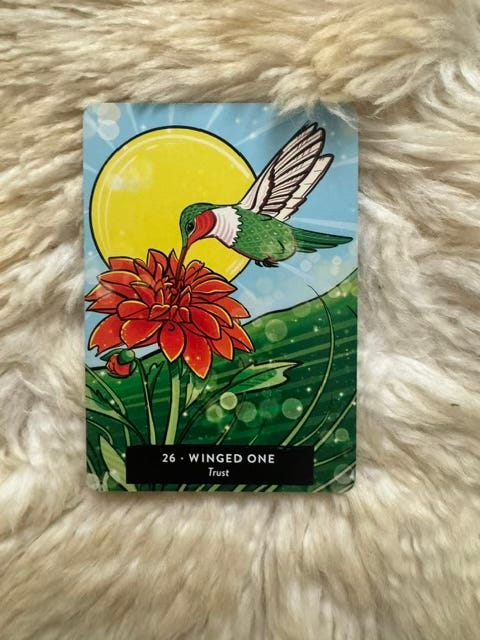
This week’s card is from Asha Frosts “The sacred medicine oracle”deck.
This week’s card, Trust, feels like the perfect energy for the collective right now.
After the powerful Blue Moon energy we’ve just moved through, it feels as though so much has been released. The last week carried an intensity to it, almost like everything was supercharged, bringing things to the surface that needed our attention. As we now move closer towards the Summer Solstice and the peak of the light later this month, there is a gentle invitation to explore our relationship with trust.
Trust can feel like such a simple word, but in reality it’s often one of the most complex relationships we have.
As I tune into the energy of the week ahead, it feels as though something may arise that asks you to lean into trust a little more deeply. It could be trusting yourself. It could be trusting another person. It could be trusting your ability to complete something you’ve been working towards, trusting a project that’s ready to be shared with the world, or trusting a relationship that’s slowly unfolding. Whatever shape it takes, it feels as though trust will become a focal point in an area of your life that is asking for your attention.
When that happens, rather than rushing past it, allow yourself to sit with it.
What is your relationship with trust?
It’s a powerful question because many of us have reasons why trust feels difficult. We may have been hurt before. We may have trusted someone who let us down. We may have poured our hearts into a project that didn’t work out the way we hoped. We may have listened to our intuition and felt confused by what happened next.
Trust asks us to remain open despite our previous experiences, and that isn’t always easy.
We hear phrases such as “trust the process” all the time, and whilst there is wisdom in those words, the reality is often more nuanced. Trust isn’t simply a mindset. It also lives within the body and nervous system.
If your nervous system has learned that trust is unsafe for any number of reasons, there can be a disconnect between what your mind wants and what your body feels. You may desperately want to trust, yet find yourself hesitating, questioning, or holding back.
If that’s the case, be gentle with yourself.
You don’t need to leap from distrust to complete faith overnight. Sometimes trust is built through tiny moments. One small step. One small choice. One small act of self-belief. Rome wasn’t built in a day, and neither is trust.
Perhaps this week is simply about finding the next 1% that helps bridge the gap.
I also feel there’s an invitation to explore the trust you have in yourself.
This is something many of us struggle with more than we realise. Life happens. We experience disappointments, losses, illnesses, challenges and setbacks. Sometimes we become disconnected from our own wisdom, our bodies, or our ability to navigate what life places in front of us.
If you’ve been through difficult experiences with your health, your body, your relationships, or your circumstances, trust can feel especially complicated.
How do we trust a body that hasn’t always done what we wanted it to do?
How do we trust ourselves after we’ve experienced hardship?
Perhaps the answer isn’t about forcing trust. Perhaps it’s about slowly rebuilding the relationship. Meeting yourself where you are. Learning to listen again. Learning to soften towards yourself rather than criticise yourself.
The image on this card feels particularly meaningful. I was immediately drawn to the hummingbird. There is something so delicate, sensitive and trusting about its energy. It moves gently yet purposefully, knowing exactly where it needs to go. It doesn’t force. It doesn’t rush. It simply follows the path in front of it.
Behind it, the great golden sun feels like a reminder that we are moving towards the Solstice, towards greater light, growth and expansion. The hummingbird reminds us that trust doesn’t have to arrive in dramatic ways. Sometimes it arrives softly, one moment at a time.
Trust doesn’t have to be a giant leap.
It can be a tiny step.
It can be a quiet decision.
It can be a gentle willingness to try again.
So as you move through the week ahead, take your time. If trust feels easy, embrace it. If trust feels difficult, honour that too. Notice where the resistance is and meet yourself with compassion rather than judgement.
Be kind to yourself.
Be patient with yourself.
And trust that wherever you are right now is exactly where you need to begin.
I hope everyone has a good week ahead, do share this with anyone it may resonate with, this is really appreciated.
All my love
Hannah X
anger is never something to be ashamed of! it’s something we can learn from and it’s such a raw emotion i think we can learn so much about ourselves from what makes us angry. beautifully written :)